
Guide
Low-Mileage Car Insurance for Retirees
How retirees who drive less can pay less: correcting declared mileage, low-mileage discounts, telematics and pay-per-mile policies, with realistic savings.

By Robert Chen · Research Writer
Published · Updated
Answer in brief
Retirement typically cuts annual mileage from 12,000–15,000 to 5,000–8,000, yet many policies still carry the commuting estimate. Three fixes, in order of saving: correct the declared mileage on a conventional policy (5–15%); enrol in telematics that rewards low mileage and daytime driving (5–30%); or move to a pay-per-mile policy, which for a 5,000-mile driver commonly saves 25–40%. Pay-per-mile is particularly well suited to retirees with a second car that is rarely driven.
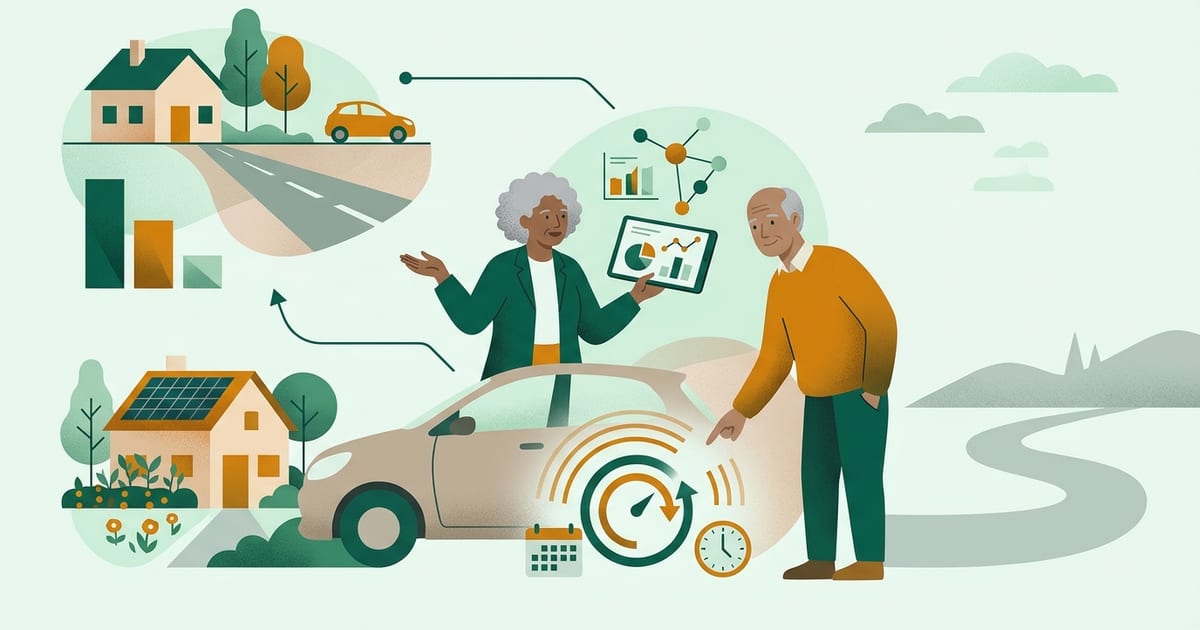
Find your real mileage
Compare two odometer readings a year apart—service records or inspection reports work. Most retirees are surprised how low the number is. Then compare it with the figure on your declarations page.
Three options
| Option | Saving for a 5,000-mile driver | Notes |
|---|---|---|
| Correct declared mileage | 5–15% | A phone call; some insurers ask for an odometer photo |
| Telematics | 10–30% | Daytime, smooth driving typical of retirees scores well |
| Pay-per-mile policy | 25–40% | Base + per-mile; daily cap for road trips; identical coverage |
Pay-per-mile for retirees
The premium is a monthly base (often $30–$70) plus a few cents per mile, measured by a plug-in device or the car's own connection. A retiree driving 400 miles a month pays roughly the base plus $20–$40. Road trips are capped per day. Coverage is identical to a standard policy.
Quote finder
Find auto insurance quotes that fit your situation
Who should not
Retirees who travel extensively by car, or who drive for part-time work, may exceed the mileage where pay-per-mile saves. For them, correcting mileage and telematics are the better fit.
Entries in this guide
Specific questions answered in more depth.
Questions & answers
How much can a retiree save by driving less?
5–15% by correcting declared mileage; 25–40% with pay-per-mile at very low mileage.
What counts as low mileage?
Under about 7,500 miles a year; many retirees drive 4,000–6,000.
Is pay-per-mile insurance good for seniors?
Often, especially for a second car or a driver under 6,000 miles a year. Coverage is the same as a standard policy.
Terms used in this guide
- Low-mileage discount
- A conventional-policy discount, typically 5–15%, for low declared annual mileage.
- Pay-per-mile insurance
- A policy priced as a monthly base plus a per-mile charge, measured by device or app. Saves most for drivers under about 7,500 miles a year.
- Telematics (usage-based insurance)
- Pricing based partly on measured driving—mileage, braking, time of day. Careful daytime drivers score well.
- Annual mileage
- Miles driven per year—a rating factor often left at commuting levels after retirement.
Sources and references
Legal figures on this page (minimum limits, filing periods, statutory benefits) are checked against the primary law or the state insurance regulator listed below. Links and figures last verified Nov 2026.
- Insurance Code § 1861.02 — rating factors and Good Driver Discount — California Legislative Information, Cal. Ins. Code § 1861.02Primary lawRates must be determined by, in decreasing order of importance, driving safety record, annual miles driven and years of driving experience; optional factors may follow. Good Driver Discount policies must be at least 20% below the rate otherwise charged.
- Fla. Stat. § 627.0652 — discount for completing an accident prevention course — Florida Senate, Fla. Stat. § 627.0652Primary lawRates for liability, PIP and collision must include a premium reduction when the principal operator is 55 or older and completes an approved course; effective three years; may be conditioned on no at-fault crash or moving violation.
- Companies may offer auto insurance discounts. No law requires discounts. — Texas Department of Insurance (2025)State insurance regulatorNo Texas law or rule mandates auto insurance discounts (for age, low mileage or anything else) or puts a time limit on them; advertising that says otherwise is misleading.
- Background on: Pay-as-you-drive auto insurance (telematics) — Insurance Information InstituteIndependent researchUsage-based and per-mile pricing models, what telematics programmes measure, and state limits on their use.
- Background on: Older drivers — Insurance Information InstituteIndependent research2023 fatal-crash involvement per 100,000 licensed drivers: 15.44 (65–74), 16.63 (75+), 24.38 all ages; state licence-renewal rules for older drivers.
- Nine ways to lower your auto insurance costs — Insurance Information InstituteConsumer guidanceShop at least three quotes; raising a deductible from $200 to $500 can cut collision/comprehensive cost 15–30%, $1,000 can save 40%+; drop physical damage on cars worth under 10× the premium; bundling, low-mileage and good-student discounts.
- What determines the price of an auto insurance policy? — Insurance Information InstituteConsumer guidanceRating factors: driving record, mileage, location, age, gender, vehicle, credit-based insurance score, coverage choices. Notes ZIP-code rating is prohibited in California and Michigan and gender rating is prohibited in seven states.
Practical guidance on this page is original editorial work. Cited sources support factual statements and do not endorse this site. Dollar ranges described as typical or illustrative are editorial estimates, not figures from these sources.
Guide
Car Insurance Discounts for Seniors
The discounts available to older drivers—mature-driver course, low mileage, retiree, bundling, pay-in-full, telematics—and which actually move the premium.
Guide
Average Car Insurance Cost for Seniors by Age
Typical full-coverage and liability premiums at 60, 65, 70, 75 and 80, how they compare with mid-life rates, and what moves them.
Guide
Car Insurance Coverage in Retirement
How coverage needs change after retirement: liability to protect savings, medical coverage, collision on an ageing car, umbrella policies, and coverage when you drive less.