
Guide
How Age Affects Car Insurance After 60
Why car insurance is cheapest in the fifties and sixties, why it begins rising around 70, what the data says about older drivers, and how insurers rate it.

By Margaret Hale · Editor
Published · Updated
Answer in brief
Car insurance is typically cheapest between about 55 and 65, with a clean record. Around 70 rates begin to rise gradually, and after 75–80 more noticeably—often 10–30% above the mid-fifties low by 75 and more beyond. The reason is per-mile data: older drivers crash less often per driver because they drive fewer miles, but per mile their crash rate rises after 70, and injury severity in a given crash rises with age. The increase is smaller than the youth surcharge and is offset by mature-driver courses, low-mileage pricing and comparing insurers.
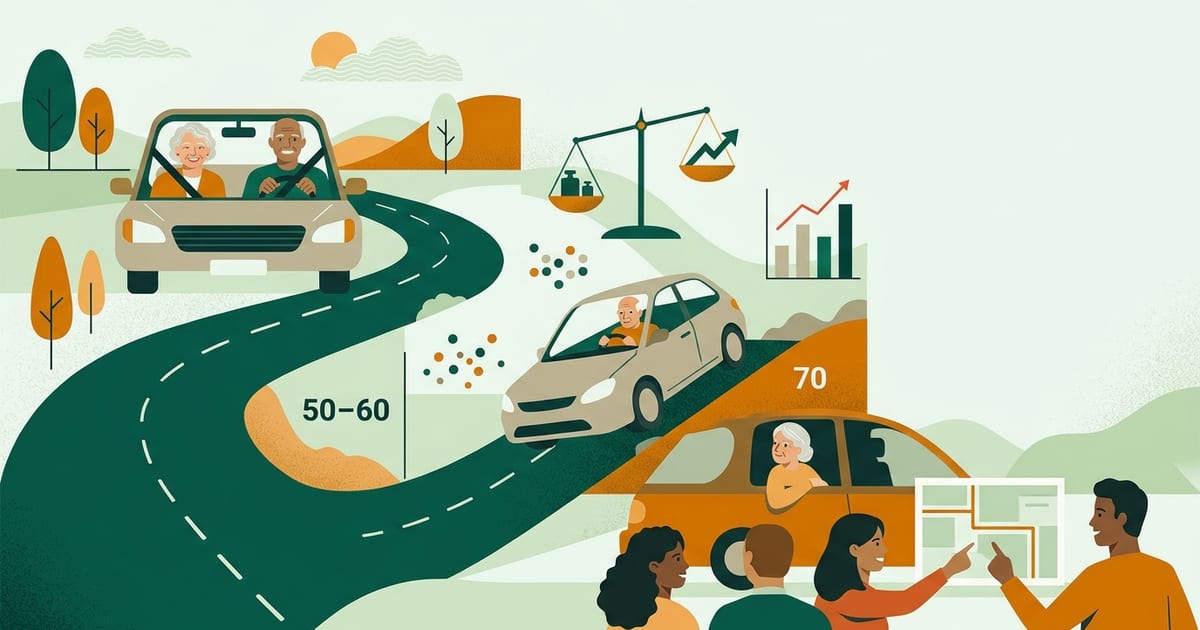
The age curve after 50
| Age | Relative premium |
|---|---|
| 50–54 | 102% |
| 55–64 | 100% (lowest) |
| 65–69 | 100–105% |
| 70–74 | 105–115% |
| 75–79 | 115–130% |
| 80+ | 130–160% |
What the research shows
Highway-safety data shows that drivers 70 and older have higher crash rates per mile than middle-aged drivers, though lower than teenagers, and that fatal-crash involvement per mile rises steeply after 80—largely because older occupants are more vulnerable to injury in a crash of the same severity. Older drivers also self-regulate: they drive fewer miles, avoid night and bad weather, and have fewer crashes per driver. Insurers see both effects and rate accordingly.
How insurers apply it
Age bands with gradually rising factors, applied to the base rate. Some insurers' bands move at 65, others at 70 and 75. Record, mileage, vehicle and territory still apply. A 72-year-old with a clean record and low mileage in a suburb often pays less than a 45-year-old commuter with a ticket.
Quote finder
Find auto insurance quotes that fit your situation
What offsets it
A mature-driver course discount (required by law in many states for drivers 55+), low-mileage or pay-per-mile pricing for retirees, keeping a clean record, and comparing insurers—because their age factors differ noticeably after 70.
Questions & answers
At what age does car insurance start going up?
Gradually around 70 for most insurers, more noticeably after 75.
Is car insurance cheaper for seniors?
In the late fifties and sixties, yes—typically the cheapest years. After 70 it rises modestly.
Why do older drivers pay more if they drive less?
Per mile, crash rates rise after 70 and injuries in a crash are more severe. Low-mileage pricing captures the fewer-miles effect.
Terms used in this guide
- Age band
- An insurer's age grouping with its own rate factor. Lowest in the late fifties and sixties; rising gradually after 70.
- Rating factor
- Any characteristic used to set a premium—age, record, mileage, vehicle, territory, coverage.
- Mature driver
- Insurer and state term for drivers roughly 55 and older, used in course-discount rules.
Sources and references
Legal figures on this page (minimum limits, filing periods, statutory benefits) are checked against the primary law or the state insurance regulator listed below. Links and figures last verified Nov 2026.
- Background on: Older drivers — Insurance Information InstituteIndependent research2023 fatal-crash involvement per 100,000 licensed drivers: 15.44 (65–74), 16.63 (75+), 24.38 all ages; state licence-renewal rules for older drivers.
- Older drivers — Insurance Institute for Highway SafetyIndependent researchCrash involvement, fragility and licensing research for drivers 70+.
- Drivers in fatal motor vehicle crashes by age, 2023 — Insurance Information Institute (2025)Statistical dataFatal-crash involvement per 100,000 licensed drivers: 42.40 (16–20), 35.34 (21–24), 28.97 (25–34), 24.18 (35–44), 21.70 (45–54), 19.45 (55–64), 15.44 (65–74), 16.63 (75+).
- What determines the price of an auto insurance policy? — Insurance Information InstituteConsumer guidanceRating factors: driving record, mileage, location, age, gender, vehicle, credit-based insurance score, coverage choices. Notes ZIP-code rating is prohibited in California and Michigan and gender rating is prohibited in seven states.
- Senior driving safety and insurance tips — Insurance Information InstituteConsumer guidanceMost insurers offer discounts to drivers over 55, some tied to approved accident-prevention courses; per-mile fatality risk rises with age because of fragility.
Practical guidance on this page is original editorial work. Cited sources support factual statements and do not endorse this site. Dollar ranges described as typical or illustrative are editorial estimates, not figures from these sources.
Guide
Average Car Insurance Cost for Seniors by Age
Typical full-coverage and liability premiums at 60, 65, 70, 75 and 80, how they compare with mid-life rates, and what moves them.
Guide
Car Insurance Discounts for Seniors
The discounts available to older drivers—mature-driver course, low mileage, retiree, bundling, pay-in-full, telematics—and which actually move the premium.
Guide
Low-Mileage Car Insurance for Retirees
How retirees who drive less can pay less: correcting declared mileage, low-mileage discounts, telematics and pay-per-mile policies, with realistic savings.